Treatment Comparisons
Sleep Apnea Mouth Guard vs. CPAP
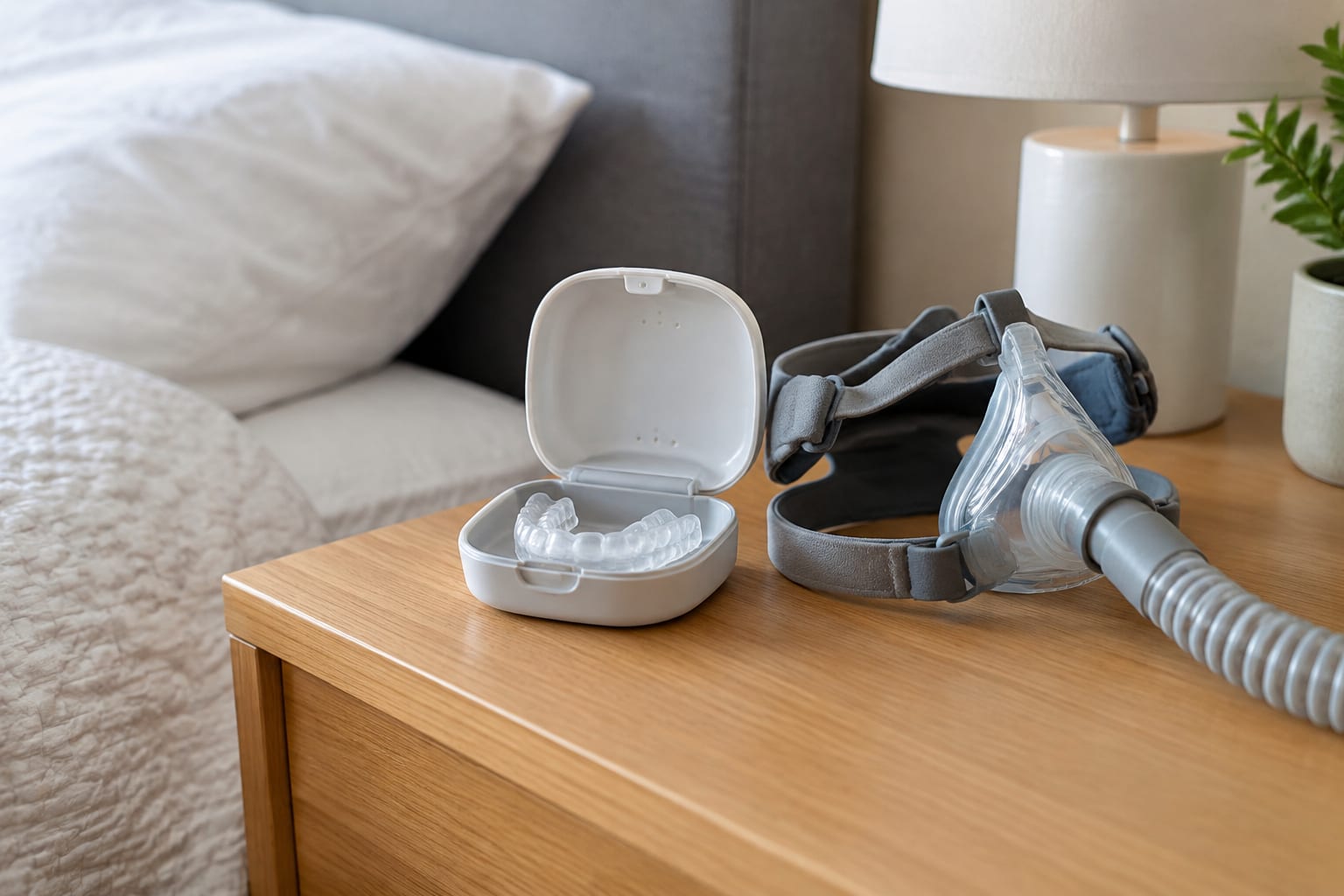
A CPAP machine and a sleep apnea mouth guard (an oral appliance) both treat obstructive sleep apnea by keeping the airway open during sleep. CPAP does this with gentle air pressure through a mask, while an oral appliance holds the lower jaw slightly forward. Dr. Jaime Lee provides dental evaluation and oral appliance therapy as part of a plan based on a medical sleep diagnosis.
What is the difference between a sleep apnea mouth guard and CPAP?
CPAP (continuous positive airway pressure) delivers a steady flow of air through a mask, which holds the airway open. A sleep apnea mouth guard is a custom appliance worn over the teeth that positions the lower jaw forward, which keeps the tongue and soft tissues from blocking the airway. CPAP is prescribed by a physician, and an oral appliance is made and adjusted by a dentist as part of that medical plan.
How does CPAP work?
A small bedside machine sends pressurized air through a tube to a mask over the nose, mouth, or both. The air pressure acts as a splint that keeps the airway from collapsing during sleep. CPAP is a standard first treatment for obstructive sleep apnea and is managed by a sleep physician.
How does an oral appliance work?
A mandibular advancement oral appliance holds the lower jaw in a forward position during sleep to help maintain an open upper airway. Dr. Lee takes records of your teeth and bite so the appliance fits closely, then adjusts it over time. Your physician confirms how well the appliance is working with follow-up sleep testing.
How do they compare?
| Sleep apnea mouth guard | CPAP | |
|---|---|---|
| How it works | Holds the lower jaw forward | Air pressure through a mask |
| Prescribed and managed by | Your physician's diagnosis, with a dentist making and adjusting the appliance | A sleep physician |
| Often used for | Mild to moderate obstructive sleep apnea, or when CPAP is not tolerated | All levels of obstructive sleep apnea |
| Noise and equipment | Silent; no power, hose, or mask | Machine, hose, and mask |
| Travel | Small and portable | Machine travels with you |
| Ongoing care | Dental checks of the fit, teeth, and jaw | Mask and equipment replacement |
Who is a sleep apnea mouth guard a good fit for?
An oral appliance often fits adults with mild to moderate obstructive sleep apnea, and people with more severe sleep apnea who cannot use CPAP. Healthy teeth and gums are needed to hold the appliance, along with jaw joints that can comfortably move forward. Dr. Lee evaluates these before an appliance is made.
When is CPAP the better fit?
CPAP is often recommended for moderate to severe obstructive sleep apnea, where it is the most consistently effective treatment. It may also be the better fit when there are not enough healthy teeth to hold an appliance. Some people use both, such as CPAP at home and an appliance when traveling, as their physician directs.
How does Dr. Lee fit into your treatment plan?
An oral appliance is made after a physician diagnoses sleep apnea, as part of that medical plan. Dr. Lee evaluates your teeth, periodontal support, jaw joints, bite, and restorations to see whether your mouth can hold an appliance comfortably. She then makes and adjusts the appliance in coordination with the plan from your physician.
What affects the cost?
The cost of oral appliance therapy depends on the appliance and the follow-up visits needed to adjust it. Coverage varies, and some medical plans cover oral appliances for diagnosed sleep apnea. Our team can review your dental benefits and the expected cost with you before treatment begins.
Frequently asked questions
Do I need a sleep study before getting a mouth guard?
Yes. Obstructive sleep apnea is diagnosed by a physician, usually with a sleep study, and an oral appliance is made as part of that medical plan.
Is an oral appliance as effective as CPAP?
CPAP reduces breathing interruptions most consistently, while many people find an oral appliance easier to wear every night. Your physician helps decide which fits your diagnosis.
Can I use an over-the-counter mouth guard for sleep apnea?
A custom appliance is fitted to your teeth and adjusted over time, which lets Dr. Lee control the jaw position and monitor your teeth and jaw joints. Talk with your physician and Dr. Lee before using any appliance for sleep apnea.
Will an oral appliance affect my teeth or jaw?
Some people notice jaw or tooth tenderness while adjusting to an appliance, and long-term use can shift the bite. Dr. Lee monitors your teeth, bite, and jaw joints at follow-up visits.
Related pages
Where is our Seattle dental office?
Smile Art is at 901 Boren Ave, Suite 1030, Seattle, WA 98104. We welcome new patients from Seattle and the surrounding neighborhoods.
Seattle, WA 98104
HoursMonday–Thursday, 8:00am–4:00pm
Phone(206) 325-7200
The Cabrini Medical Tower garage entrance is at 1010 Marion St. The building entrance is on Boren Ave; Dr. Lee is in Suite 1030. Parking for a Smile Art visit does not require validation. Directions to the garage. Check posted rates when you park.