Treatment Comparisons
Fillings vs. Onlays vs. Crowns
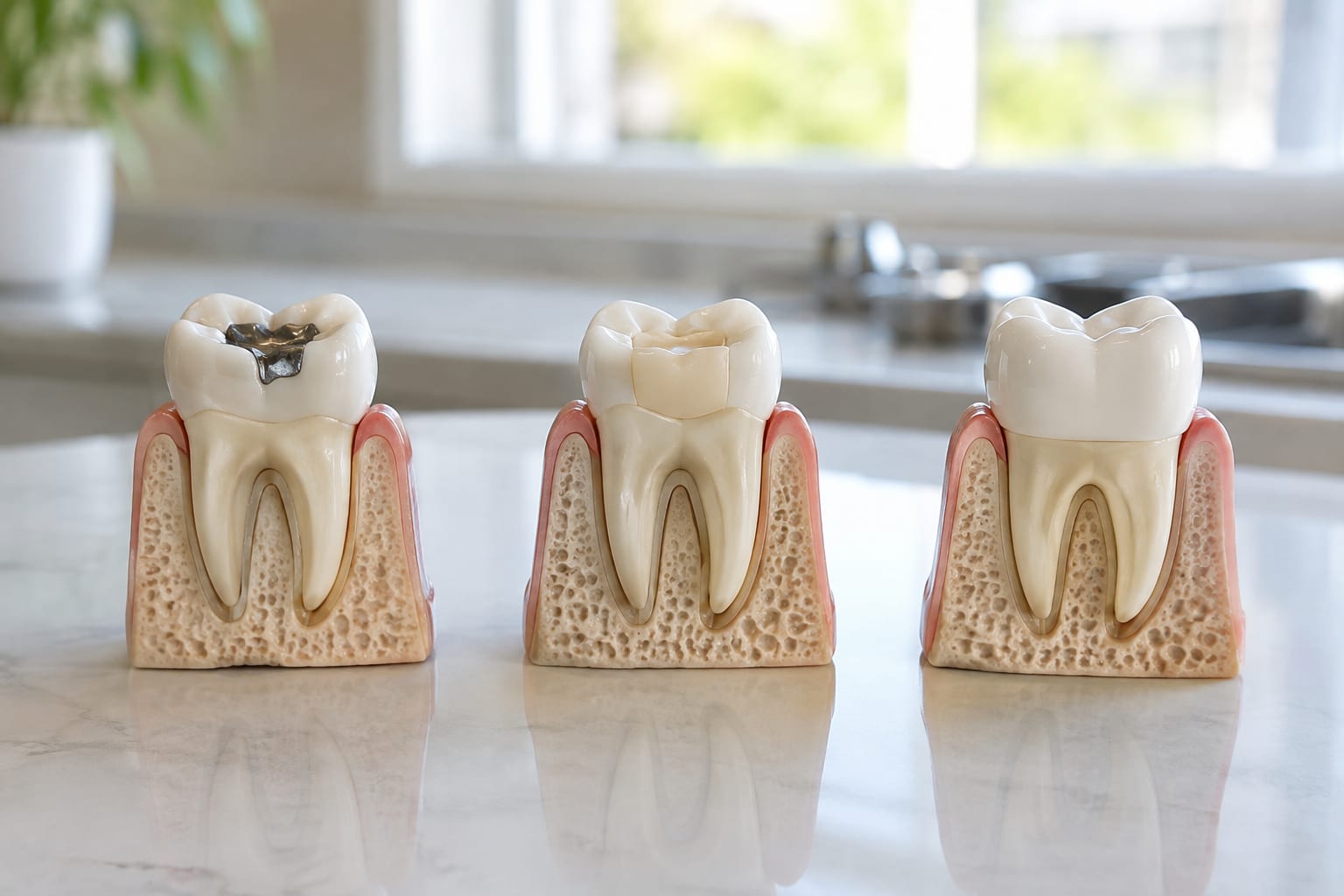
Fillings, onlays, and crowns all restore a tooth that has decay or damage, and they differ in how much of the tooth they cover. A filling repairs a smaller area, an onlay rebuilds part of the chewing surface, and a crown covers the whole visible tooth. Dr. Jaime Lee recommends the restoration that protects your tooth while keeping as much healthy tooth structure as possible.
What is the difference between a filling, an onlay, and a crown?
The three restorations sit on a scale of coverage. A filling replaces a small to moderate area of a tooth, an onlay replaces one or more of the tooth's cusps (the raised points on the chewing surface), and a crown covers the entire tooth above the gumline. The more of the tooth that is weakened, the more coverage it needs.
When is a filling enough?
A filling fits when the decay or damage is limited and the surrounding walls of the tooth remain strong. Dr. Lee removes the decay and fills the space with tooth-colored material shaped to match the tooth. Fillings are usually completed in a single visit.
When does an onlay make sense?
An onlay fits when damage is too large for a filling but much of the tooth is still healthy, such as when a cusp is weakened or broken. It is custom-made to replace the missing part and bonded to the tooth, so it reinforces the tooth without covering it completely. Onlays keep more natural tooth structure than a crown.
When is a crown needed?
A crown fits when most of the tooth is weakened, such as after a large break, extensive decay, or root canal treatment. It covers the whole tooth to hold it together and protect it from further cracking. Smile Art provides both same-day and lab-made crowns.
How do they compare?
| Filling | Onlay | Crown | |
|---|---|---|---|
| Covers | A small to moderate area | One or more cusps | The whole visible tooth |
| Tooth structure kept | The most | Much of the tooth | The least |
| Made | Directly in the tooth | Custom-made, then bonded | Custom-made, then placed |
| Typical use | Limited decay or damage | A weakened or broken cusp | A tooth weakened throughout |
How does Dr. Lee decide which one your tooth needs?
Dr. Lee evaluates how much healthy tooth remains, where the damage is, and the forces your bite places on the tooth, with X-rays to assess below the surface. She recommends the most conservative restoration that will protect the tooth over time. She explains her reasoning and the alternatives so you can guide your care.
What affects the cost?
The cost depends on the type of restoration, its material, and how many surfaces of the tooth are involved. Many dental plans cover fillings at a different level than onlays and crowns. Our team explains your coverage and expected cost before you commit to treatment.
Frequently asked questions
Why would Dr. Lee recommend an onlay instead of a crown?
An onlay keeps more of your natural tooth when the damage is limited to part of the chewing surface. Dr. Lee recommends a crown when more of the tooth needs protection.
Can a large filling be replaced with a crown?
Yes. When a large filling weakens the tooth or breaks down, Dr. Lee may recommend an onlay or crown to restore and protect it.
Do all teeth with root canal treatment need crowns?
The amount of healthy tooth structure that remains and the forces placed on the tooth help determine whether a crown is needed. Dr. Lee evaluates these factors before recommending a crown.
Is the treatment comfortable?
Each restoration is completed with the area numbed, and Dr. Lee checks your bite before you leave. Our aftercare guides explain what to expect afterward.
Related pages
Where is our Seattle dental office?
Smile Art is at 901 Boren Ave, Suite 1030, Seattle, WA 98104. We welcome new patients from Seattle and the surrounding neighborhoods.
Seattle, WA 98104
HoursMonday–Thursday, 8:00am–4:00pm
Phone(206) 325-7200
The Cabrini Medical Tower garage entrance is at 1010 Marion St. The building entrance is on Boren Ave; Dr. Lee is in Suite 1030. Parking for a Smile Art visit does not require validation. Directions to the garage. Check posted rates when you park.