Treatment Comparisons
Dental Implants vs. Bridges
A dental implant and a dental bridge both replace a missing tooth with a fixed tooth that stays in place. An implant replaces the tooth's root with a post in the jawbone, while a bridge is supported by crowns on the teeth on either side of the gap. Dr. Jaime Lee provides both at Smile Art and recommends the option that fits your bone, gums, and neighboring teeth.
What is the difference between an implant and a bridge?
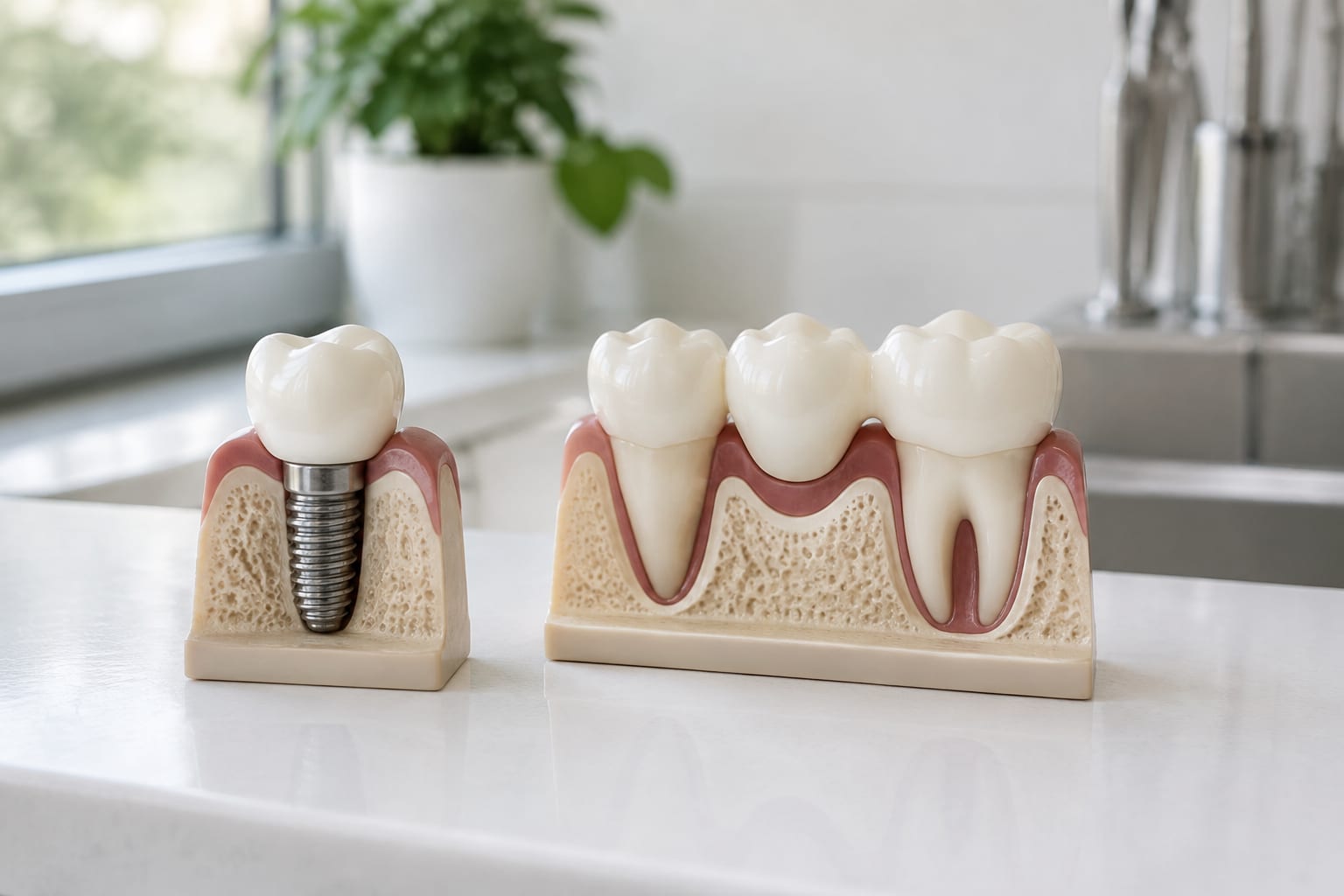
The main difference is what supports the new tooth. An implant stands on its own, anchored in the jawbone where the tooth root used to be. A bridge is anchored to the neighboring teeth, which are shaped and covered with crowns to hold the replacement tooth between them.
How does a dental implant work?
A dental implant is a small post placed in the jawbone, where it bonds with the bone as it heals. Once the implant is secure, a connector and a custom crown are attached to complete the tooth. Because the implant stands in the bone, it replaces a missing tooth without involving the teeth beside it.
How does a dental bridge work?
A traditional bridge is a single restoration made of a replacement tooth joined to two crowns. Dr. Lee reshapes the teeth on either side of the gap so the crowns fit over them, and the bridge is then cemented in place. Bridges do not involve surgery, so they are often completed in fewer visits than an implant.
How do implants and bridges compare?
| Dental implant | Dental bridge | |
|---|---|---|
| Support | A post in the jawbone | Crowns on the neighboring teeth |
| Neighboring teeth | Left untouched | Reshaped to hold the crowns |
| Jawbone | Stimulated by the implant, which helps preserve it | No root replacement, so the bone under the gap can shrink over time |
| Procedure | Minor surgery, then healing before the crown | No surgery; usually completed in a few visits |
| Cleaning | Brushed and flossed like a natural tooth | Cleaned under the replacement tooth with floss threaders or similar aids |
| Best suited to | Healthy bone and gums, untouched neighboring teeth | Neighboring teeth that already need crowns, or when surgery is not preferred |
Who is a good fit for a dental implant?
An implant often fits patients who have enough healthy bone to support the post and whose neighboring teeth are healthy and free of large fillings. When bone has thinned after a tooth was lost, Dr. Lee may recommend a bone graft to rebuild it before placing the implant. Good overall health and healthy gums support the healing an implant needs.
Who is a good fit for a dental bridge?
A bridge often fits patients whose neighboring teeth already have large fillings or crowns, since covering those teeth also protects them. It can also suit patients who prefer to avoid surgery or who want the tooth replaced in a shorter time. Healthy gums and strong neighboring teeth are needed to support a bridge.
How does Dr. Lee help you choose?
Dr. Lee evaluates the space, your bone and gums, and the condition of the teeth on either side of the gap, with X-rays to assess the bone. She explains which options fit your mouth, how each would affect your neighboring teeth, and what each involves over time.
What affects the cost of each option?
The cost of an implant depends on the implant, the crown, and any bone grafting needed to prepare the site. The cost of a bridge depends on the number of teeth it spans and the materials used. Our team reviews your dental benefits and the expected cost of each option with you before treatment begins.
Frequently asked questions
Is an implant or a bridge better for one missing tooth?
Both can replace one missing tooth well. An implant leaves the neighboring teeth untouched, while a bridge can be a good choice when those teeth already need crowns. Dr. Lee recommends the option that fits your bone, gums, and neighboring teeth.
Does getting a bridge damage the neighboring teeth?
A bridge requires reshaping the neighboring teeth so crowns can fit over them. When those teeth already have large fillings, the crowns can also protect them.
Can a bridge be supported by implants?
Yes. When several teeth in a row are missing, implants can support a bridge in place of natural teeth. Dr. Lee explains whether this option fits your situation.
Does insurance cover implants or bridges?
Coverage varies by plan, and many plans cover part of a bridge or an implant crown. Smile Art accepts all PPO dental plans; our team can check what your plan covers before you come in.
Related pages
Where is our Seattle dental office?
Smile Art is at 901 Boren Ave, Suite 1030, Seattle, WA 98104. We welcome new patients from Seattle and the surrounding neighborhoods.
Seattle, WA 98104
HoursMonday–Thursday, 8:00am–4:00pm
Phone(206) 325-7200
The Cabrini Medical Tower garage entrance is at 1010 Marion St. The building entrance is on Boren Ave; Dr. Lee is in Suite 1030. Parking for a Smile Art visit does not require validation. Directions to the garage. Check posted rates when you park.